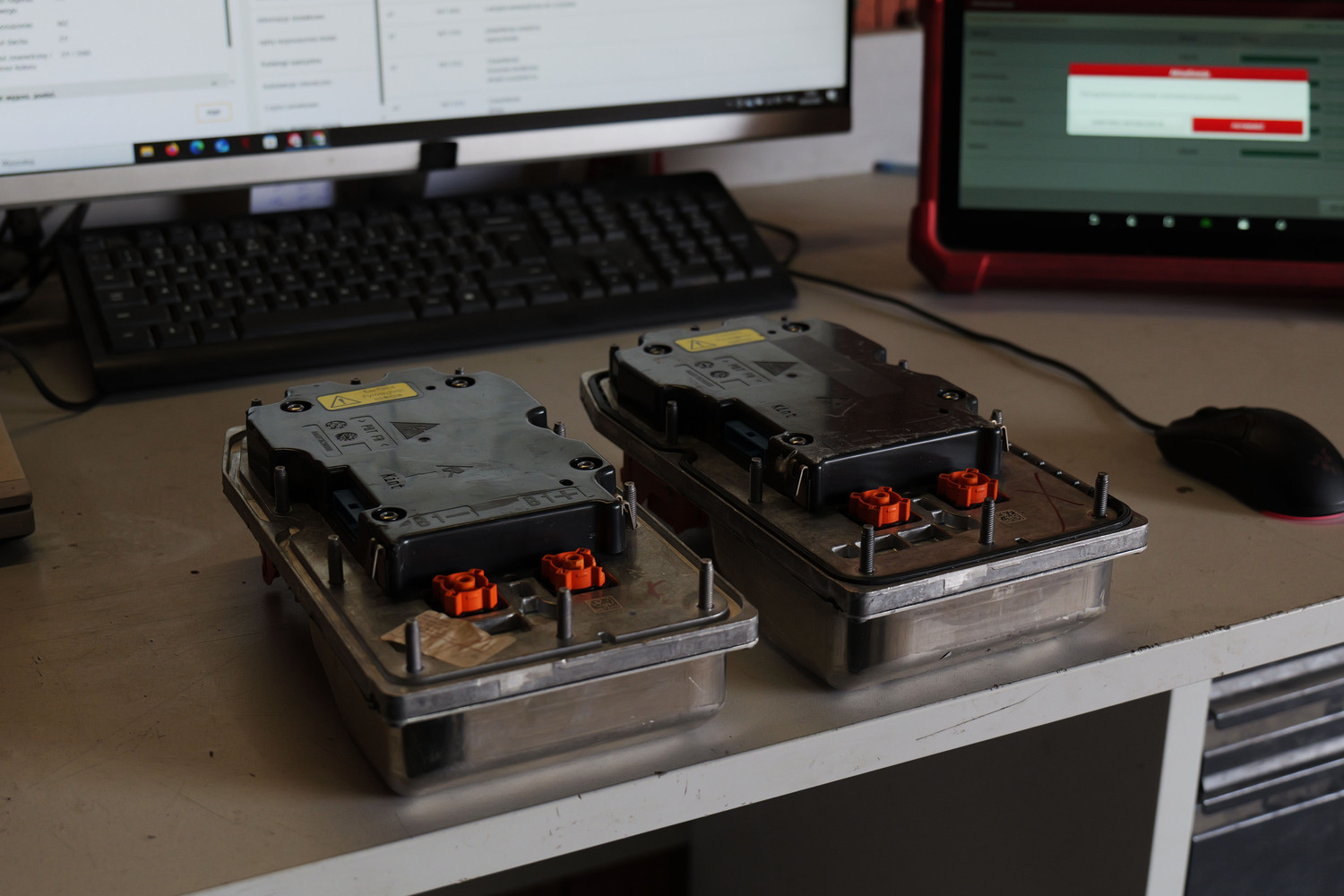
A weak hybrid battery does not always mean that the complete high-voltage battery pack needs to be replaced. Depending on its condition, age and type of degradation, hybrid battery regeneration may offer another option.
The process is designed to identify differences between battery modules, improve balance within the pack and restore more stable operation where technically possible. However, regeneration is not a universal solution, and proper diagnostics should always come first.
Quick answer:
Hybrid battery regeneration is a specialist process used to assess, balance and improve the performance of a high-voltage battery pack. It can be useful when individual modules have become uneven but the battery is still in a condition that makes regeneration technically worthwhile.
What is hybrid battery regeneration?
A hybrid battery pack consists of multiple cells or modules working together as one system. Over time, these modules can age at slightly different rates.
Some may retain good capacity, while others become weaker. As the difference between them increases, the vehicle may begin to show symptoms such as reduced electric assistance, higher fuel consumption or hybrid system warning messages.
Hybrid battery regeneration focuses on evaluating these differences and improving the balance of the battery pack where possible.
Depending on the battery design and its condition, the process can involve:
- measuring individual module or block voltages
- checking capacity and internal resistance
- analysing charging and discharging behaviour
- identifying weak or abnormal modules
- balancing battery sections
- reconditioning suitable modules
- checking electrical connections
- inspecting the battery cooling system
The objective is not simply to clear a warning light. The battery should be assessed as a complete system to determine whether regeneration can provide a stable and worthwhile result.
Hybrid battery regeneration at a glance
1. Diagnostics
The battery is tested to determine its actual condition and identify differences between modules.
2. Analysis
Weak modules, temperature issues and electrical abnormalities are identified.
3. Regeneration
Suitable battery sections are balanced or reconditioned using specialist equipment.
4. Verification
The battery is tested again to confirm whether operating parameters have improved.
Why do hybrid batteries become unbalanced?
Battery degradation is a natural process. Even when all modules were similar when the vehicle was new, they may not age at exactly the same rate.
Differences can develop because of:
- vehicle age
- high mileage
- temperature exposure
- different charging and discharging behaviour
- cooling system problems
- manufacturing differences between cells or modules
- long periods of inactivity
Eventually, one weaker section may begin to limit the performance of the complete battery pack.
Important:
A difference between battery modules does not automatically mean the complete battery is unusable. Detailed diagnostics are needed to determine whether the pack can still be repaired or regenerated.
What are the signs that a hybrid battery may need attention?
Hybrid battery degradation often develops gradually rather than appearing as a sudden failure.
Common symptoms include:
- hybrid system warning lights
- rapid changes in the battery charge indicator
- reduced electric driving
- the combustion engine running more frequently
- higher fuel consumption
- reduced acceleration or electric assistance
- unusually frequent battery cooling fan operation
- stored battery-related fault codes
These symptoms can also be caused by other hybrid system faults, so battery regeneration should never be recommended based on symptoms alone.
Professional hybrid and EV diagnostics should establish the actual cause first.
How does hybrid battery regeneration work?
The exact procedure varies between battery types and vehicle manufacturers, but the general process follows several stages.
1
Initial battery diagnostics
Fault codes, battery voltage, temperature readings and live data are analysed to understand the symptoms and identify abnormal battery behaviour.
2
Battery pack inspection
The condition of electrical connections, modules, cooling components and other parts of the battery assembly can be inspected.
3
Module testing
Individual battery sections are compared to identify modules with lower capacity, abnormal resistance or significantly different performance.
4
Regeneration and balancing
Suitable modules may go through controlled charging and discharging procedures designed to improve balance and usable performance.
5
Final testing
The battery is tested again to verify whether differences between modules have been reduced and the pack is operating correctly.
Battery regeneration vs battery repair
The terms battery repair and battery regeneration are sometimes used interchangeably, but they do not necessarily describe exactly the same work.
Battery regeneration generally focuses on restoring balance and improving the performance of battery modules that are still suitable for further use.
Battery repair can involve physically replacing faulty modules, connectors, sensors or other damaged components.
In practice, both procedures may be combined when working on an ageing high-voltage battery.
Regeneration, repair or replacement?
| Option |
When it may make sense |
Main consideration |
| Regeneration |
Battery modules remain usable but have become uneven. |
Condition of the complete pack must justify the process. |
| Repair |
Specific modules or components have developed faults. |
Remaining battery sections should still be in acceptable condition. |
| Replacement |
Degradation affects a significant part of the battery pack. |
Usually provides the most comprehensive solution when degradation is widespread. |
There is no single option that is always best.
The correct decision should depend on battery condition, vehicle age, repair costs and the expected future use of the vehicle.
When does hybrid battery regeneration make sense?
Regeneration is most likely to be considered when the battery still has a reasonable overall condition but has developed differences between individual modules.
It may be worth investigating when:
- the battery has become noticeably unbalanced
- capacity differences exist between modules
- the battery has not suffered major physical damage
- most of the pack remains in usable condition
- diagnostics indicate that regeneration could improve battery operation
This is why the first step should always be measurement and diagnosis rather than deciding on a repair method in advance.
When is regeneration not the right solution?
There are also situations where regeneration would provide little benefit.
For example, complete battery replacement may be more appropriate when:
- a large number of modules have significantly reduced capacity
- the complete battery pack is heavily degraded
- there is extensive corrosion or physical damage
- the battery has already undergone multiple unsuccessful repairs
- safety-related damage has occurred
- the expected result would only provide a very short-term improvement
Regeneration should not be used to hide a failing battery.
The aim is to restore more stable operation where the battery condition makes this technically reasonable. A severely degraded battery may require a different repair strategy.
Can hybrid battery regeneration improve fuel economy?
Potentially, but only when poor battery performance is contributing to higher fuel consumption.
A healthy hybrid system uses the electric motor and combustion engine together efficiently. When the battery cannot store or supply energy correctly, the engine may need to operate more often.
If successful regeneration improves battery operation, the hybrid system may again be able to use electrical assistance more effectively.
However, fuel consumption is influenced by many factors, so an increase in fuel use should never be treated as proof of a battery fault.
How long does a regenerated hybrid battery last?
There is no universal lifespan for a regenerated battery.
The result depends on:
- the original condition of the battery
- vehicle age
- condition of individual modules
- quality of the diagnostic and regeneration process
- battery cooling performance
- vehicle usage
- operating temperatures
A battery with generally healthy modules and a limited imbalance may have much better prospects than a heavily degraded pack where multiple sections are already near the end of their usable life.
Does regeneration restore a battery to new condition?
Myth
Battery regeneration makes an old battery identical to a brand-new battery.
Fact
Regeneration can improve balance and performance in a suitable battery, but it cannot reverse every form of chemical ageing.
This distinction is important.
Professional battery regeneration should be based on realistic expectations and the measured condition of the battery pack.
Why battery cooling should also be checked
Regenerating the battery without investigating why it deteriorated may leave the underlying problem unresolved.
Battery cooling is particularly important.
Blocked air intakes, contaminated cooling fans or other airflow problems can cause high battery temperatures and accelerate degradation.
For this reason, the cooling system should be considered as part of the wider battery diagnosis.
Why professional battery diagnostics matter
High-voltage battery work requires specialist equipment, technical knowledge and appropriate safety procedures.
A professional diagnosis may include:
- fault code analysis
- live battery data
- module voltage comparison
- capacity testing
- internal resistance measurements
- temperature analysis
- charging and discharging tests
HybridElectric workshops provide specialist HV Battery Regeneration and high-voltage battery services for hybrid and electric vehicles.
Hybrid battery regeneration FAQ
Is hybrid battery regeneration cheaper than replacement?
It can be, depending on the battery and the work required. However, price should not be the only factor. Regeneration only makes sense when the battery condition supports a reliable result.
Can every hybrid battery be regenerated?
No. Some batteries are too heavily degraded, damaged or unsuitable for regeneration. Diagnostics are necessary before deciding whether the process is appropriate.
Does regeneration remove hybrid battery fault codes?
The purpose of regeneration is to address battery condition, not simply remove fault codes. Faults should only be cleared after the underlying problem has been identified and corrected.
Is regeneration the same as replacing one battery module?
Not necessarily. Replacing a damaged module is a repair, while regeneration usually involves testing, conditioning and balancing suitable battery sections. Depending on the battery, both procedures may be used together.
Should an older hybrid battery be tested even without a warning light?
It can be useful, particularly when buying a used hybrid or when vehicle behaviour, fuel consumption or battery charge patterns have changed.
Find a hybrid battery specialist
Hybrid battery regeneration requires more than general vehicle diagnostics. The high-voltage battery must be tested properly before deciding whether regeneration, repair or replacement offers the most sensible solution.
HybridElectric connects specialist workshops experienced in hybrid and electric vehicle batteries, high-voltage diagnostics and advanced repair.
You can find your nearest specialist through our HybridElectric workshop network.
Is your hybrid battery losing performance?
Have the high-voltage battery professionally diagnosed and find out whether regeneration, repair or replacement is the right solution.
Find a workshop
HV Battery Regeneration