If you are considering changing your car, one question appears again and again: are hybrid cars worth it?
For many drivers, the answer can be yes. Hybrid vehicles can reduce fuel consumption, work particularly well in urban driving and provide some of the benefits of electric driving without requiring regular charging.
However, hybrids are not perfect for every situation. Their advantages depend heavily on how and where the vehicle is used, while the additional high-voltage technology introduces components that conventional cars simply do not have.
Quick answer:
Hybrid cars can be worth it for drivers who spend a lot of time in cities, mixed traffic or stop-start conditions and want lower fuel consumption without relying on charging infrastructure. They may offer fewer advantages for drivers who spend almost all of their time at sustained motorway speeds.
Are hybrid cars worth it?
Whether a hybrid car is worth buying depends mostly on your driving pattern.
Hybrid technology is designed to reduce the amount of work performed by the combustion engine. It does this by using an electric motor during situations where conventional engines are often less efficient, such as moving away from a stop, low-speed driving and repeated acceleration.
Energy can also be recovered during braking and stored in the high-voltage battery for later use.
This makes hybrids particularly well suited to environments where the vehicle frequently slows down and accelerates again.
A hybrid can make a lot of sense if…
- you regularly drive in cities
- you spend time in stop-start traffic
- you want lower fuel consumption
- you cannot easily charge an EV at home
- you want flexibility for longer journeys
A hybrid may be less compelling if…
- almost all your driving is motorway-based
- you already have convenient home charging
- a fully electric vehicle fits your daily range easily
- you want the simplest possible drivetrain
- your annual mileage is very low
Why hybrid cars work so well in cities
Urban driving is where hybrid technology often shows its strongest advantage.
A conventional combustion engine frequently operates inefficiently when a vehicle is constantly accelerating, braking and idling.
A hybrid can use its electric motor to assist during these periods and may shut the combustion engine down completely when it is not needed.
Regenerative braking also allows the vehicle to recover some of the energy that would normally be lost as heat.
Where hybrids often feel most natural:
City streets, commuting, traffic jams, suburban routes and mixed-speed journeys give the hybrid system frequent opportunities to switch between electric and combustion power.
What are the main advantages of a hybrid car?
Lower fuel use
Electric assistance reduces the workload placed on the combustion engine.
Regenerative braking
Energy that would otherwise be lost during deceleration can be recovered and reused.
No charging required
Conventional full hybrids normally charge themselves while driving.
Quiet low-speed driving
Electric operation can make urban driving smoother and quieter.
Long-distance flexibility
The combustion engine removes the need to plan charging stops on longer trips.
Proven technology
Hybrid drivetrains have now been used on European roads for many years.
Do hybrid cars really save fuel?
They can, but the amount saved depends on how the car is driven.
A hybrid generally benefits most from situations where electric assistance and regenerative braking are used frequently.
That means the difference compared with a conventional car can be much more noticeable in urban traffic than during a long motorway journey at a constant speed.
Fuel economy is also influenced by:
- vehicle weight
- engine size
- hybrid system design
- outside temperature
- driving style
- tyre pressure
- battery condition
A poorly functioning hybrid battery can also reduce efficiency because the combustion engine may need to operate more frequently.
Do you need to charge a hybrid car?
That depends on the type of hybrid.
Full hybrid
No external charging is normally required. The battery is charged through regenerative braking and the drivetrain.
Plug-in hybrid
The larger battery can be charged externally to allow longer electric-only journeys.
If you are unsure about the differences, our guide to how hybrid cars work explains full hybrids, plug-in hybrids and mild hybrids in more detail.
Are hybrid cars good for motorway driving?
Yes, but motorway driving does not always allow a hybrid to use its strongest advantages.
At sustained higher speeds, the combustion engine may operate for longer periods and there are fewer opportunities for regenerative braking.
This means the fuel-saving advantage compared with an efficient conventional car may become smaller.
However, hybrids can still be practical motorway vehicles because they retain the range and quick refuelling of a combustion engine.
What are the disadvantages of hybrid cars?
Hybrid vehicles also come with compromises.
More drivetrain complexity
A hybrid combines conventional mechanical systems with high-voltage electrical technology.
Battery ageing
High-voltage batteries gradually lose capacity as they become older.
Specialist repairs
Battery, inverter and high-voltage faults require appropriate diagnostic knowledge.
Extra weight
Batteries and electric drivetrain components add weight compared with some conventional vehicles.
These disadvantages do not mean that hybrids are unreliable. They simply mean that maintenance and diagnostics can differ from a conventional petrol or diesel vehicle.
How long do hybrid batteries last?
Battery lifespan is one of the biggest concerns for people considering a used hybrid.
There is no single mileage at which a hybrid battery automatically fails.
Many high-voltage batteries continue operating for well over 150,000 kilometres, and some remain functional beyond 200,000 or 300,000 kilometres.
Battery health depends on:
- age
- mileage
- battery chemistry
- operating temperature
- cooling system condition
- vehicle usage
- differences between individual modules
Our detailed guide to hybrid battery lifespan explains what affects battery condition over time.
Buying used?
Battery age and mileage are useful information, but professional diagnostics can provide a much clearer picture of the actual condition of a high-voltage battery.
Does a hybrid battery always need replacing when it fails?
No.
A battery-related fault can have several different causes.
Depending on the battery, diagnostics may reveal:
- individual weak modules
- battery imbalance
- cooling system problems
- damaged electrical connections
- sensor faults
In suitable cases, hybrid battery regeneration or repair may be an alternative to replacing the complete pack.
Are hybrid cars expensive to maintain?
Many routine maintenance items are similar to those found in conventional cars.
Hybrids can still require:
- engine oil and filters
- tyres
- suspension components
- coolant
- air conditioning servicing
- brake inspections
The main difference is the addition of high-voltage components such as the battery, inverter, electric motor and associated cooling systems.
These components do not automatically require regular replacement, but specialist diagnostics may be needed if a fault appears.
You can find more detail in our guide to hybrid car maintenance.
Do hybrid brakes last longer?
They can.
Regenerative braking allows the electric motor to slow the vehicle while recovering energy. This means the conventional friction brakes may be used less frequently.
Brake pads can therefore wear more slowly in some hybrid vehicles.
However, reduced use can also create another issue: brake discs and calipers can suffer from corrosion or sticking if they are not inspected properly.
So lower brake wear does not mean the braking system can be ignored.
Are hybrid cars reliable?
Hybrid technology itself has been used in mass-produced vehicles for decades.
Many hybrid models have developed strong reputations for long-term reliability.
At the same time, an older hybrid contains components that eventually age just like those in any other vehicle.
When assessing reliability, it is more useful to consider:
- the specific model
- service history
- vehicle age
- battery condition
- mileage
- previous repairs
The word “hybrid” alone does not tell you whether an individual vehicle is in good condition.
Is buying a used hybrid worth it?
A used hybrid can offer strong value, particularly if the vehicle has been maintained correctly.
However, the high-voltage battery becomes more important as the vehicle gets older.
Used hybrid checklist:
✓ Check the service history
✓ Check for hybrid warning messages
✓ Watch the battery charge indicator
✓ Check fuel consumption
✓ Listen for excessive battery fan noise
✓ Consider a professional battery diagnostic
✓ Inspect conventional mechanical components
✓ Check previous battery repairs if applicable
Hybrid or electric car?
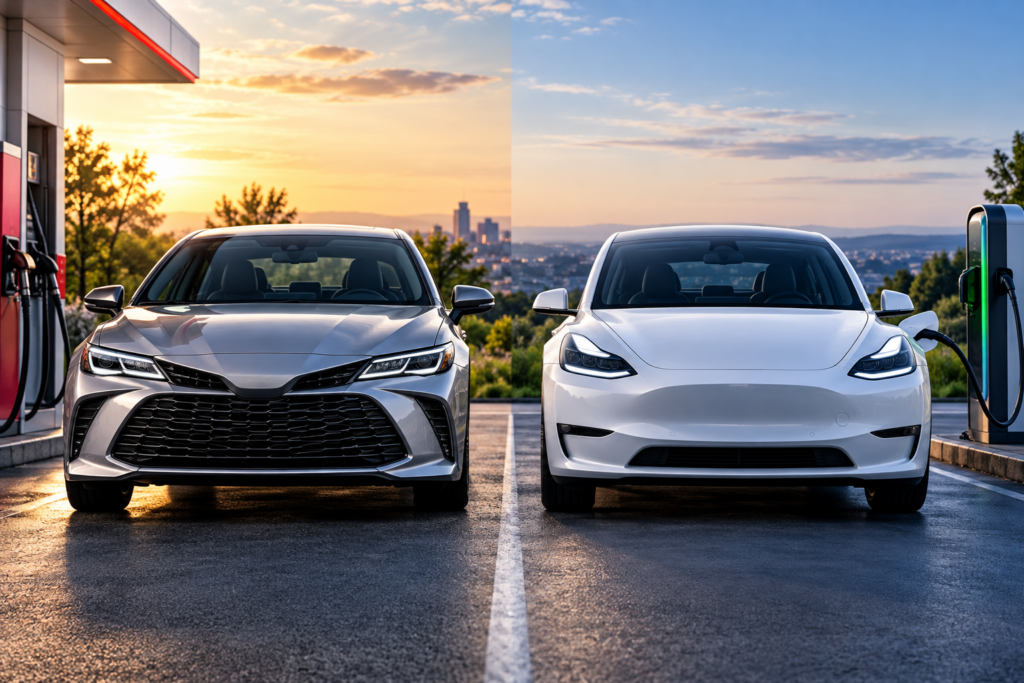
For some drivers, the real question is not whether to buy a hybrid, but whether to skip the combustion engine completely and choose an EV.
An electric vehicle can make a lot of sense when you have convenient home charging and your everyday journeys fit comfortably within its range.
A hybrid can provide additional flexibility when charging is difficult or when long journeys are common.
Our full hybrid vs electric car comparison looks at charging, range, running costs and maintenance in more detail.
Who should consider a hybrid car?
A hybrid can be particularly well suited to a driver who wants some of the efficiency benefits of electrification without changing the way they refuel.
Urban commuter
Frequent stop-start driving makes good use of regenerative braking and electric assistance.
Mixed-distance driver
City driving during the week and longer trips at weekends can suit the flexibility of a hybrid drivetrain.
No home charger
A conventional hybrid provides electrified driving without requiring access to a charging point.
Driver moving away from petrol or diesel
A hybrid can offer a familiar transition towards electrified driving.
Who may be better with something else?
A hybrid may not provide the best value if your driving pattern does not allow the electric side of the drivetrain to contribute much.
For example:
- very low annual mileage may make fuel savings less important
- constant motorway driving may reduce the efficiency advantage
- easy home charging may make a fully electric vehicle more attractive
- drivers looking for maximum electric-only range may prefer a plug-in hybrid or EV
Are hybrid cars worth it in the long term?
For the right driver, they can be.
The strongest argument for a hybrid is not simply that it uses less fuel. It is the combination of efficiency, easy refuelling and flexibility.
The main long-term consideration is the condition of the high-voltage system as the vehicle ages.
Proper maintenance and early diagnosis of battery, inverter or cooling issues can help prevent smaller faults from developing into more expensive problems.
The important question is not only “is a hybrid worth it?”
A better question is whether a hybrid suits your real driving pattern. The more often the electric system can contribute, the more sense the technology usually makes.
Are hybrid cars worth it? FAQ
Are hybrid cars worth buying in 2026?
They can be a strong option for drivers who want lower fuel consumption, easy long-distance travel and no dependence on charging infrastructure. The best choice still depends on how the vehicle will be used.
Are hybrid cars worth it for motorway driving?
Hybrids can work well on motorways, but their efficiency advantage is often smaller than in urban driving because there are fewer opportunities for regenerative braking and electric-only operation.
Are hybrids cheaper to run than petrol cars?
They can be, especially in city and mixed driving. Actual savings depend on fuel prices, vehicle efficiency, mileage and driving conditions.
Is a used hybrid a good idea?
A well-maintained used hybrid can be a good purchase. Battery condition, service history and overall vehicle condition are particularly important when evaluating an older example.
How expensive is a hybrid battery to replace?
Costs vary significantly between vehicles and battery types. A battery-related fault also does not always require complete replacement, which is why specialist diagnostics should come first.
Is a hybrid better than an EV?
Neither technology is automatically better. Hybrids provide greater flexibility when charging is difficult, while EVs can be more attractive for drivers with easy charging access and suitable daily driving distances.
Hybrid specialists across the HybridElectric network
Whether you already own a hybrid or are considering buying one, understanding the condition of its high-voltage system becomes increasingly important as the vehicle ages.
HybridElectric connects workshops specialising in hybrid and electric vehicle diagnostics, battery systems, maintenance and high-voltage repair.
You can find your nearest specialist through our HybridElectric workshop network.
Already driving a hybrid?
Find a specialist HybridElectric workshop for hybrid diagnostics, battery services, maintenance and high-voltage repairs.
Find a workshop
Explore our services