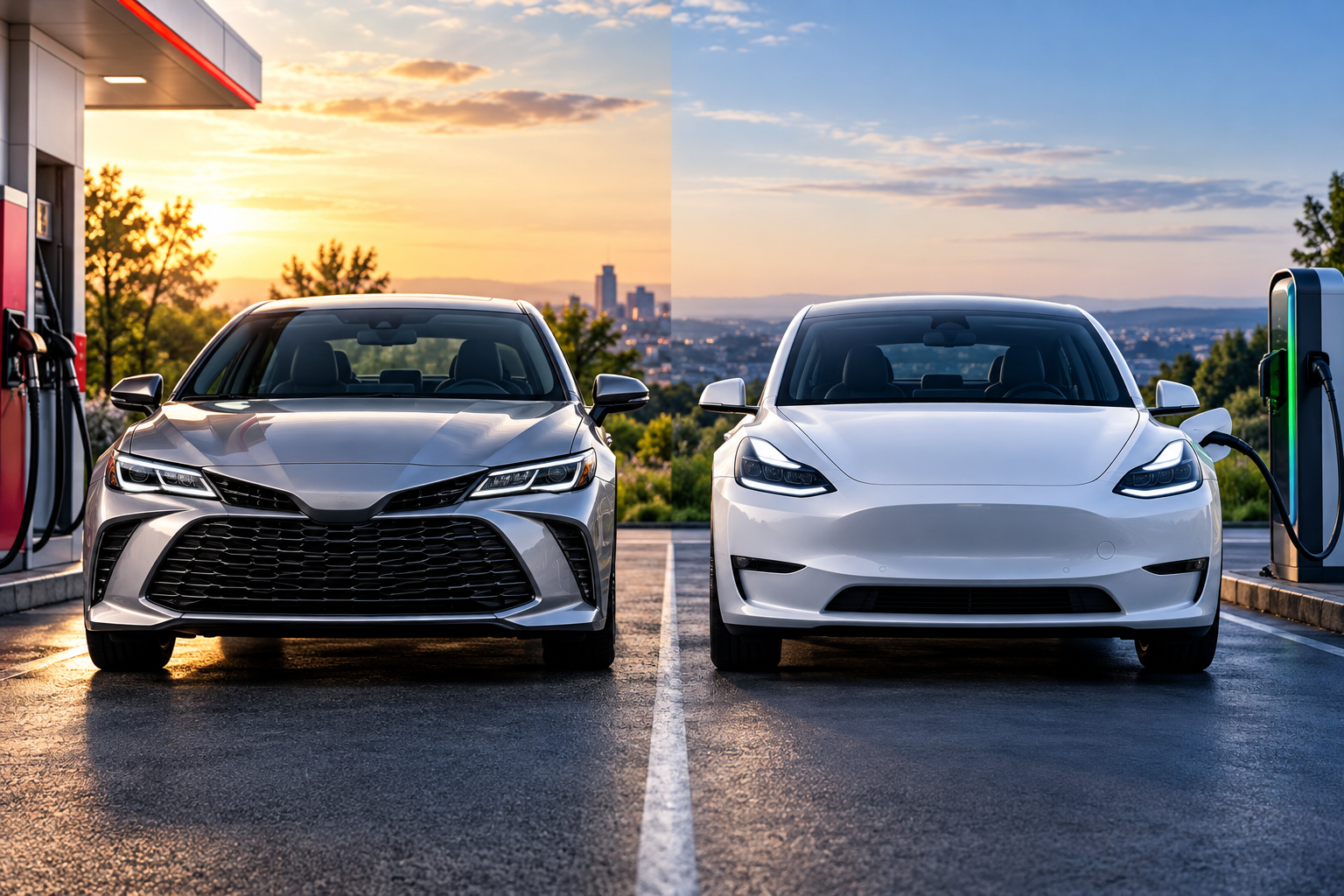
Choosing between a hybrid vs electric car is no longer a niche decision. Drivers across Europe now have access to conventional hybrids, plug-in hybrids and fully electric vehicles across almost every segment of the market.
Both technologies use electric motors and high-voltage batteries, but the way they work in everyday driving is very different. A hybrid combines electric power with a combustion engine, while a fully electric vehicle relies entirely on electricity.
So which one makes more sense? The answer depends on how you drive, where you charge, how far you travel and what you expect from your vehicle.
Quick answer:
A hybrid can be a practical choice if you want lower fuel consumption without depending on public or home charging. An electric car can offer lower local emissions, quiet driving and simpler propulsion, but works best when regular charging is convenient.
What is the difference between a hybrid and an electric car?
The biggest difference is the source of energy used to move the vehicle.
Hybrid car
Uses a combustion engine together with an electric motor and high-voltage battery.
The vehicle can automatically switch between petrol or diesel power, electric assistance or a combination of both.
Electric car
Uses one or more electric motors powered entirely by a rechargeable high-voltage battery.
There is no conventional combustion engine and the battery must be charged from an external electricity source.
If you want to understand hybrid technology in more detail, read our complete guide to how a hybrid car works.
Where does a plug-in hybrid fit?
A plug-in hybrid sits between a conventional hybrid and a fully electric car.
It still has a combustion engine, but it also uses a larger high-voltage battery that can be charged from an external power source.
This allows many plug-in hybrids to complete everyday journeys using electric power while retaining the combustion engine for longer distances.
Think of it as a spectrum:
Mild hybrid → Full hybrid → Plug-in hybrid → Fully electric vehicle.
What is it like to drive a hybrid car?
A full hybrid manages its energy automatically.
At lower speeds, the electric motor may move the vehicle without using the combustion engine. During stronger acceleration, both power sources can work together.
When the vehicle slows down, regenerative braking can recover part of the energy and return it to the high-voltage battery.
The key advantage is convenience. A conventional hybrid does not normally need to be connected to a charger.
What is it like to drive an electric car?
Electric vehicles deliver power differently.
Electric motors provide torque immediately, which often makes acceleration feel smooth and responsive. There are also fewer mechanical changes during driving because many EVs use a single-speed transmission.
Another noticeable difference is noise. Without a combustion engine operating in the background, electric cars are generally quieter at lower speeds.
The main habit drivers need to learn is charging.
Do hybrid cars need charging?
Mild hybrid
No external charging is normally required.
Full hybrid
Charges its battery through regenerative braking and the vehicle’s drivetrain.
Plug-in hybrid
Can be connected to a charger to maximise electric-only driving.
Electric car
Must be charged externally because electricity is its only source of propulsion energy.
Home charging can change the EV experience
Access to reliable home charging is one of the biggest factors when deciding whether an electric vehicle fits your lifestyle.
If the vehicle can be charged overnight, many owners begin each day with enough energy for normal daily driving.
Without home or workplace charging, an EV owner may need to rely more heavily on public infrastructure.
That does not necessarily make electric driving impractical, but it changes the level of planning required.
Which has better driving range?
Traditional hybrids usually have an advantage when the priority is travelling long distances without stopping to charge.
Once fuel is available, the vehicle can continue operating regardless of battery charge.
Fully electric vehicles depend on battery capacity and access to charging infrastructure.
Modern EV ranges have improved significantly, but actual range still depends on factors such as:
- battery capacity
- driving speed
- outside temperature
- heating and air conditioning use
- vehicle weight
- driving style
- road conditions
Why does temperature matter more for electric cars?
Temperature affects all vehicle batteries, but the effect becomes more noticeable when the battery is the vehicle’s only source of driving energy.
Cold conditions can reduce available range and increase energy use because the battery and passenger compartment may need heating.
High temperatures can also affect battery performance and long-term degradation.
Modern EVs use sophisticated thermal management systems to keep the high-voltage battery within an appropriate operating range.
Hybrid vs electric car running costs
Running costs depend heavily on where and how the vehicle is used.
Hybrid costs depend on
- fuel prices
- fuel economy
- driving conditions
- vehicle maintenance
- battery condition
EV costs depend on
- electricity prices
- home vs public charging
- energy consumption
- battery thermal management
- vehicle maintenance
Charging an EV at home can be very different financially from relying on rapid public charging, just as hybrid fuel consumption can vary significantly between city driving and sustained motorway use.
Which is more efficient in city driving?
Both technologies can perform well in cities.
Hybrid vehicles benefit from frequent regenerative braking and can often use electric power during low-speed driving.
Electric vehicles go further by eliminating combustion engine use completely.
Stop-start traffic is also well suited to regenerative braking because repeated deceleration provides opportunities to recover energy.
Which is better for long motorway journeys?
For drivers who regularly travel long distances, a hybrid can offer additional flexibility because refuelling is quick and does not depend on charger availability.
Electric vehicles can also handle long-distance travel, particularly models with large batteries and fast-charging capability, but journey planning may be more important.
A simple way to think about it:
🏙️ Mostly city: hybrid or EV can both work very well.
🏠 Home charging: makes an EV significantly easier to live with.
🛣️ Frequent long trips: hybrid can offer more flexibility.
🔌 Short daily journeys: EV or plug-in hybrid can make strong use of electric driving.
Do electric cars need less maintenance?
A fully electric drivetrain contains fewer conventional mechanical components than a vehicle with a combustion engine.
There is no engine oil, exhaust system, conventional fuel system or many of the service items associated with internal combustion engines.
However, an EV is not maintenance-free.
It still requires attention to:
- tyres
- brakes
- suspension
- air conditioning
- cooling systems
- high-voltage components
- battery thermal management
- electrical systems
What maintenance does a hybrid car need?
A hybrid combines conventional mechanical systems with high-voltage technology.
That means routine maintenance can include both traditional service items and additional hybrid-specific checks.
Areas worth monitoring include:
- engine oil and filters
- braking system
- high-voltage battery condition
- battery cooling
- inverter cooling
- electrical diagnostics
Read our complete guide to hybrid car maintenance for a closer look at servicing electrified vehicles.
What about battery lifespan?
Both hybrid and electric vehicles use high-voltage rechargeable batteries that gradually degrade over time.
Battery ageing is influenced by:
- temperature
- vehicle age
- charging behaviour
- driving conditions
- battery chemistry
- thermal management
In a hybrid, the battery is usually smaller and the vehicle can continue using its combustion engine when additional energy is required.
In a fully electric vehicle, battery capacity directly influences the available driving range.
Battery condition matters more than mileage alone.
Two vehicles with similar mileage can have batteries in very different condition depending on age, temperature, charging history and how they have been used.
Are hybrid and EV batteries repairable?
In some cases, yes.
A battery-related warning does not automatically mean the complete high-voltage battery needs to be replaced.
Specialist diagnostics can help identify:
- weak battery modules
- cell imbalance
- cooling problems
- electrical connection faults
- battery management system issues
Depending on the battery and the type of fault, repair or regeneration may be technically possible.
HybridElectric workshops provide specialist hybrid and EV diagnostics and repair services.
Hybrid vs electric car: environmental differences
A fully electric vehicle produces no tailpipe emissions during driving because it has no combustion engine.
A hybrid still burns fuel, but electric assistance can reduce fuel consumption and tailpipe emissions compared with a similar conventional vehicle.
The complete environmental impact is more complex and also depends on manufacturing, battery production, vehicle lifespan and the electricity mix used for charging.
For drivers, the most visible difference remains simple: an EV can drive without producing exhaust gases at the vehicle, while a hybrid cannot eliminate combustion engine use completely.
Hybrid or electric car: which should you choose?
There is no universal winner. The right drivetrain depends on how the vehicle will actually be used.
A hybrid may suit you if…
- you regularly travel long distances
- you cannot easily charge at home
- you want electric assistance without changing your refuelling habits
- you drive in mixed city and motorway conditions
- you want flexibility on longer journeys
An electric car may suit you if…
- you can charge conveniently at home or work
- most daily journeys fit comfortably within the vehicle’s range
- you want fully electric driving
- you mainly drive predictable routes
- you are comfortable planning charging on longer trips
What about buying a used hybrid or EV?
When buying a used electrified vehicle, battery condition becomes an important part of the assessment.
Mileage alone does not tell you everything about high-voltage battery health.
A professional diagnostic check can provide more information about battery behaviour, fault history and other high-voltage systems.
For older hybrids in particular, it can also help identify module imbalance or early signs of battery degradation.
Both technologies need specialist knowledge
Although hybrids and electric vehicles use different drivetrain strategies, both rely heavily on high-voltage technology and advanced electronics.
Batteries, inverters, electric motors and high-voltage wiring require different diagnostic procedures from conventional vehicle systems.
This is why access to specialist workshops becomes increasingly important as the European hybrid and EV fleet grows.
You can find experienced specialists through the HybridElectric workshop network.
Hybrid vs electric car FAQ
Is a hybrid better than an electric car?
Not always. A hybrid may be more convenient for frequent long-distance travel or drivers without easy charging access, while an EV can be a strong choice for drivers who can charge regularly and want fully electric driving.
Which is cheaper to run: hybrid or electric?
It depends on fuel prices, electricity costs, charging location, vehicle efficiency and driving habits. Home-charged EVs can have very different running costs from vehicles relying mainly on public rapid charging.
Which is better for long journeys?
Hybrids can offer additional flexibility because refuelling is quick and widely available. Modern EVs can also handle long trips, but charging speed, battery range and infrastructure become more important.
Do hybrid cars have electric range?
Full hybrids can often drive short distances or operate briefly using electric power alone. Plug-in hybrids use larger batteries and can normally travel much further without using the combustion engine.
Do electric cars last longer than hybrids?
Vehicle lifespan depends on far more than drivetrain type. Battery condition, maintenance, climate, mileage and vehicle design all influence long-term reliability.
Do both hybrids and EVs need specialist workshops?
High-voltage batteries, inverters and electrical drivetrain systems require suitable equipment, training and safety procedures. Specialist support is particularly important when high-voltage faults occur.
Hybrid and electric vehicle specialists
Whether you drive a hybrid, plug-in hybrid or fully electric vehicle, modern electrified drivetrains require accurate diagnostics when problems occur.
HybridElectric connects specialist workshops with experience in batteries, high-voltage systems, inverters, diagnostics and advanced hybrid and EV repairs.
Looking for a hybrid or EV specialist?
Find a HybridElectric workshop for professional diagnostics, maintenance, battery services and high-voltage repairs.
Find a workshop
Explore our services