A hybrid car combines a conventional combustion engine with one or more electric motors. Instead of relying entirely on petrol, diesel or electricity, the vehicle automatically uses both power sources to improve efficiency and reduce fuel consumption.
Hybrid technology is now used across a wide range of vehicles, from small city cars to SUVs and performance models. However, not every hybrid works in exactly the same way.
In this guide, we explain how hybrid cars work, the main types of hybrid systems, what happens during driving and braking, how long hybrid batteries can last and what owners should know about maintenance.
Quick answer:
A hybrid car uses both an internal combustion engine and an electric motor. The vehicle can use either power source individually or combine them depending on speed, battery charge and driving conditions. Energy recovered during braking is stored in a high-voltage battery and used again later.
How does a hybrid car work?
The basic idea behind a hybrid car is simple: use electricity when it is efficient and use the combustion engine when additional power or longer driving range is needed.
The exact strategy varies between manufacturers, but most hybrid systems contain several key components.
Combustion Engine
Provides power for longer journeys, higher speeds and situations where additional energy is required.
Electric Motor
Can move the vehicle independently or assist the combustion engine during acceleration.
Hybrid Battery
Stores electrical energy that can later be used by the electric motor.
Inverter
Controls and converts electrical energy between the battery and electric drivetrain.
Regenerative Braking
Recovers energy during deceleration instead of wasting all of it as heat.
Control Electronics
Decide how the different power sources should work together at any given moment.
The driver normally does not need to control any of this manually. The vehicle continuously decides which power source offers the best combination of efficiency and performance.
How does a hybrid car start moving?
In many full hybrid vehicles, low-speed driving can begin using only the electric motor.
Because electric motors produce torque immediately, they are particularly effective when pulling away from a stop or driving slowly through urban traffic.
If more power is required, the combustion engine can start automatically and work together with the electric motor.
One of the biggest advantages:
The driver usually does not need to choose between petrol and electric driving. The hybrid control system manages the transition automatically.
What happens while driving a hybrid car?
A hybrid drivetrain constantly changes how energy is used depending on the situation.
1
Starting and low-speed driving
Some hybrid vehicles can use the electric motor without starting the combustion engine.
2
Acceleration
The combustion engine and electric motor may work together when more power is needed.
3
Steady-speed driving
The vehicle selects the most efficient combination of engine and electric power for current conditions.
4
Braking and deceleration
Regenerative braking converts part of the vehicle’s movement back into electrical energy.
5
Vehicle stopped
The combustion engine can switch off completely when it is not required.
What is regenerative braking?
Regenerative braking is one of the technologies that makes a hybrid car different from a conventional petrol or diesel vehicle.
In a traditional car, much of the vehicle’s kinetic energy is converted into heat by the brakes and lost.
A hybrid can use its electric motor as a generator during deceleration. Instead of using all of that energy as heat, part of it is converted back into electricity and stored in the high-voltage battery.
Energy flow in simple terms:
Vehicle movement
→
Electric motor
→
Electrical energy
→
HV battery
This energy can later be used again to help move the vehicle.
What are the different types of hybrid cars?
The word “hybrid” covers several different drivetrain designs. Understanding the differences makes it much easier to compare vehicles.
Full Hybrid
Can typically use the combustion engine, electric motor or both. Short periods of electric-only driving may be possible.
Plug-in Hybrid
Uses a larger battery that can be charged externally and normally offers a longer electric-only driving range.
Mild Hybrid
Uses electrical assistance to support the combustion engine but normally cannot drive meaningful distances using electric power alone.
What is a full hybrid car?
A full hybrid, sometimes called a self-charging hybrid, can use both electric and combustion power without needing to be plugged into an external charger.
The battery is charged through regenerative braking and, depending on the vehicle design, by the combustion engine.
This type of system is particularly effective in urban environments where frequent braking allows the vehicle to recover energy repeatedly.
What is a plug-in hybrid?
A plug-in hybrid vehicle, or PHEV, combines a combustion engine with a larger high-voltage battery.
Unlike a conventional full hybrid, the battery can be charged from an external power source.
This allows many plug-in hybrids to travel significantly further using electricity alone before the combustion engine is required.
Once battery charge becomes lower, the vehicle can continue operating using its hybrid drivetrain.
What is a mild hybrid?
A mild hybrid usually uses a smaller electrical system that assists the combustion engine during acceleration and allows more efficient start-stop operation.
Unlike many full hybrids, a mild hybrid normally cannot drive independently using the electric motor for any significant distance.
Its main purpose is to reduce the workload of the combustion engine and improve efficiency.
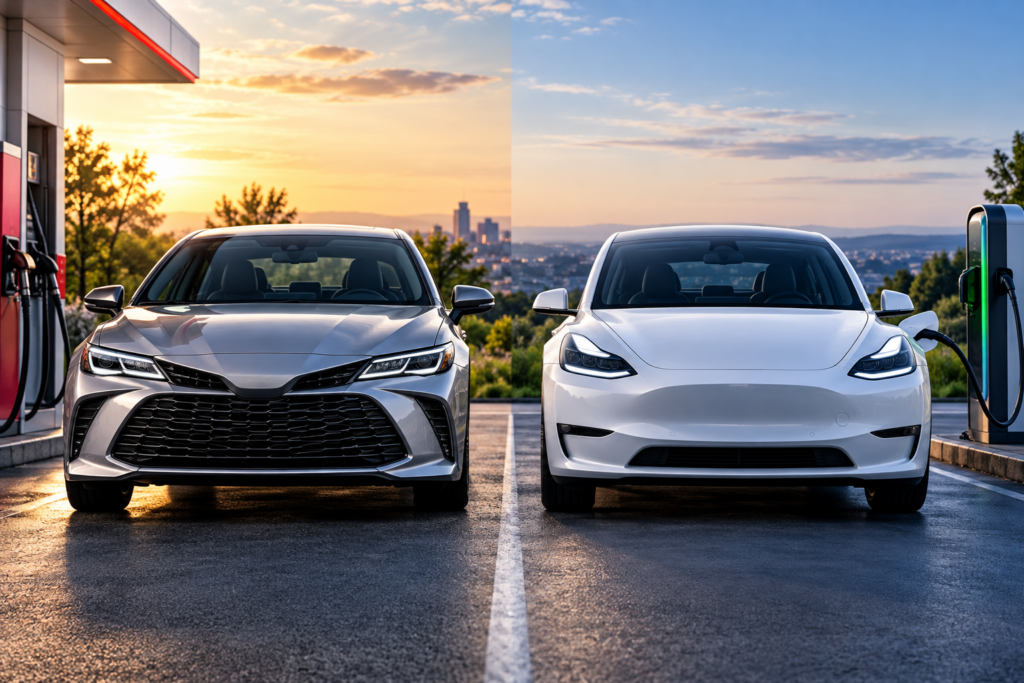
Hybrid, plug-in hybrid or electric car?
There is no single drivetrain that is best for every driver.
Hybrid
Combines petrol or diesel with electric assistance and does not normally require external charging.
Plug-in Hybrid
Offers greater electric-only capability while retaining a combustion engine for longer journeys.
Electric Vehicle
Uses an electric drivetrain without a conventional combustion engine and relies on external charging.
The best choice depends on driving patterns, access to charging, typical journey length and personal preferences.
What battery does a hybrid car use?
Hybrid vehicles normally contain two different battery systems.
The first is a conventional low-voltage battery used for electronics and control systems. The second is the much larger high-voltage hybrid battery used by the electric drivetrain.
Depending on the vehicle, the HV battery may use technologies such as nickel-metal hydride or lithium-ion cells.
The battery is designed to operate within a controlled charge range rather than constantly being charged from completely empty to completely full. The battery management system controls this automatically.
How long does a hybrid battery last?
There is no exact lifespan that applies to every hybrid battery.
Battery condition depends on:
- vehicle age
- mileage
- battery technology
- operating temperatures
- driving conditions
- cooling system condition
- differences between individual battery modules
Many hybrid batteries operate successfully for well over 150,000 kilometres and some remain functional beyond 200,000 or 300,000 kilometres.
For a deeper explanation, read our guide to hybrid battery lifespan.
What are the benefits of a hybrid car?
Lower fuel consumption
Electric assistance can reduce the amount of work required from the combustion engine.
Energy recovery
Regenerative braking allows energy that would otherwise be lost to be reused.
Efficient city driving
Hybrids can be particularly effective in stop-start traffic where electric drive and regeneration are used frequently.
No charging required
Conventional full hybrids do not normally need to be connected to an external charger.
Are there disadvantages to hybrid cars?
Hybrid technology also introduces additional complexity.
Compared with a conventional vehicle, a hybrid drivetrain may contain:
- a high-voltage battery
- one or more electric motors
- an inverter
- additional cooling systems
- high-voltage wiring
- specialised control electronics
These systems can require specialist knowledge when faults occur.
However, complexity should not automatically be interpreted as poor reliability. Proper maintenance and accurate diagnostics are more important than simply counting the number of components.
Do hybrid cars need special maintenance?
A hybrid still needs many of the same maintenance items as a conventional vehicle, including engine oil, filters, brakes, tyres and suspension checks.
The difference is that technicians may also need to consider the high-voltage system.
Important hybrid maintenance areas:
✓ High-voltage battery condition
✓ Battery cooling system
✓ Inverter and power electronics
✓ Hybrid cooling circuits
✓ Electrical diagnostics
✓ Regenerative braking system
Our complete guide to hybrid car maintenance explains these areas in more detail.
Can any workshop repair a hybrid car?
Conventional maintenance can often be carried out using familiar workshop procedures, but high-voltage systems require additional knowledge and safety precautions.
Hybrid batteries, inverters and electric drive components can operate at potentially dangerous voltages.
Work involving these systems should therefore be performed by technicians with the correct training, tools and diagnostic equipment.
HybridElectric workshops provide specialist hybrid and EV services, including diagnostics, battery work and high-voltage repairs.
Is a hybrid car good for city driving?
City driving is one of the situations where many hybrid systems perform particularly well.
Frequent stopping and braking allows the vehicle to recover energy through regenerative braking, while low-speed driving provides more opportunities to use the electric motor.
A conventional combustion engine is often least efficient in exactly these stop-start conditions, which is why hybrid technology can provide meaningful benefits in urban traffic.
Are hybrid cars good for motorway driving?
A hybrid can still be efficient on longer journeys, but the advantage may be different from city driving.
At sustained motorway speeds, regenerative braking occurs less frequently and the combustion engine may operate for longer periods.
Efficiency then depends heavily on the specific vehicle, drivetrain design, speed and driving conditions.
Do hybrid cars need to be plugged in?
Full hybrid
Normally no. The battery is charged automatically while the vehicle is being driven.
Plug-in hybrid
Yes, if you want to make full use of the larger battery and electric-only driving capability.
How do you know if a hybrid battery is becoming weaker?
Battery degradation can develop gradually.
Possible signs include:
- reduced electric driving
- rapid changes in battery charge level
- higher fuel consumption
- more frequent combustion engine operation
- reduced performance
- hybrid system warning messages
These symptoms can also have other causes, so professional diagnostics should always come before assuming that the battery needs replacement.
A hybrid battery warning does not automatically mean replacement.
Depending on battery condition, diagnostics may show that repair or regeneration is possible. The correct decision should be based on actual measurements rather than the warning light alone.
Why hybrid technology continues to matter
The automotive market is moving towards greater electrification, but this transition includes more than fully electric vehicles.
Hybrid and plug-in hybrid cars continue to play an important role because they combine electric driving technology with the flexibility of a combustion engine.
At the same time, the growing number of older hybrid vehicles on European roads creates increasing demand for independent workshops capable of diagnosing and repairing high-voltage systems.
HybridElectric is building a network of specialists focused on these technologies. Workshops interested in developing their hybrid and EV capabilities can learn more about how to join the HybridElectric network.
Hybrid car FAQ
What is a hybrid car?
A hybrid car combines a combustion engine with an electric motor and high-voltage battery. The vehicle automatically manages the two power sources to improve efficiency.
Do hybrid cars charge themselves?
Full hybrids recover energy through regenerative braking and can also charge the battery while driving. Plug-in hybrids can additionally be charged from an external electricity source.
Can a hybrid car drive without petrol?
Some full hybrids can travel short distances using only electric power. Plug-in hybrids can usually travel further electrically. The capability varies considerably between models.
How long does a hybrid battery last?
There is no universal lifespan. Many batteries operate for well over 150,000 kilometres, but age, mileage, temperature, vehicle use and battery design all affect condition.
Are hybrid cars expensive to repair?
Repair costs depend on the fault. Many conventional components are serviced in a similar way to other vehicles, while batteries, inverters and high-voltage systems require specialist diagnostics.
Is a hybrid better than an electric car?
Neither is universally better. The best option depends on driving habits, charging access, journey length, vehicle requirements and personal priorities.
Find a hybrid car specialist
Hybrid vehicles combine conventional mechanics with high-voltage electrical technology. As they age, correct diagnosis becomes increasingly important when battery, inverter or electrical system problems appear.
The HybridElectric workshop network connects specialists experienced in hybrid and electric vehicle diagnostics, maintenance and repair.
Looking for a hybrid specialist?
Find a HybridElectric workshop for specialist hybrid diagnostics, battery services, maintenance and high-voltage repairs.
Find a workshop
Explore our services