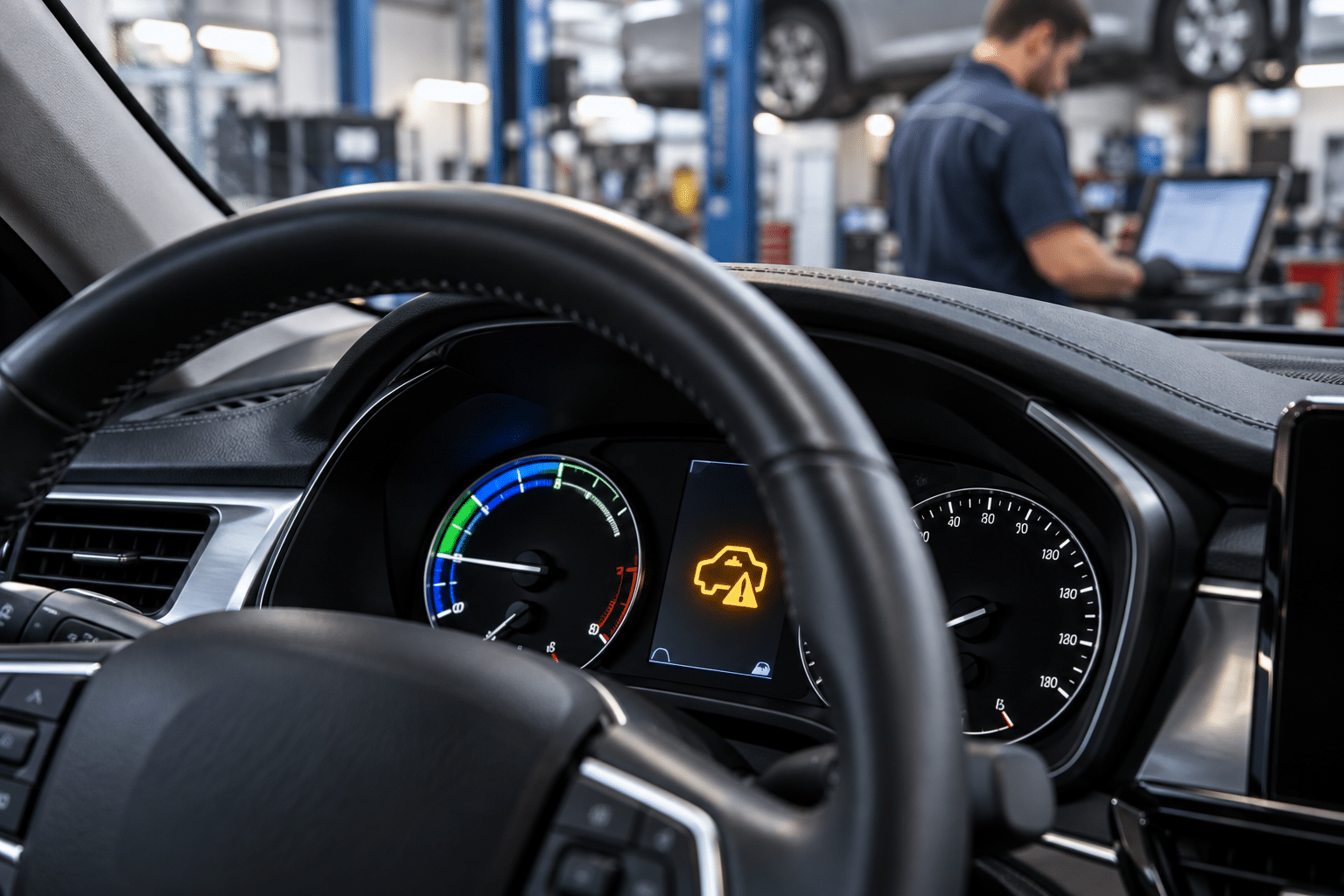
A hybrid warning light can appear for many different reasons. Sometimes the cause is relatively simple, while in other cases the warning may indicate a fault involving the high-voltage battery, inverter, cooling system or another part of the hybrid drivetrain.
The important thing is not to assume that every hybrid warning means the battery needs replacing. Modern hybrid vehicles contain multiple electronic systems working together, and similar dashboard messages can be triggered by very different faults.
Quick answer:
A hybrid warning light means the vehicle has detected an abnormal condition somewhere within the hybrid or high-voltage system. The cause can range from battery degradation and overheating to inverter, sensor, cooling or electrical faults. Proper diagnostics are needed to identify the actual problem.
What does a hybrid warning light mean?
Hybrid vehicles use a network of sensors and control modules to continuously monitor the combustion engine, electric motor, high-voltage battery and power electronics.
If one of these systems begins operating outside its expected parameters, the vehicle can display a hybrid system warning.
Depending on the manufacturer and model, you may see messages such as:
- Check Hybrid System
- Hybrid System Malfunction
- Hybrid System Fault
- Check EV System
- Power System Warning
- High Voltage System Fault
Some vehicles use a dedicated hybrid warning symbol, while others display a general warning light together with a message on the instrument cluster.
The wording may differ, but the principle is the same: the vehicle has detected something that requires further investigation.
What are the most common causes of a hybrid warning light?
There is no single component responsible for every hybrid warning. The complete system needs to be considered.
High-voltage battery
Module imbalance, reduced capacity, abnormal voltage or battery management faults.
Inverter
Power electronics faults, overheating or problems with electrical energy conversion.
Cooling system
Restricted airflow, coolant problems, faulty pumps or excessive component temperatures.
Sensors
Incorrect temperature, voltage or current readings can trigger system warnings.
Electrical connections
Corrosion, damaged wiring or poor connections can affect communication within the high-voltage system.
Control electronics
Communication or software-related faults may also cause a hybrid warning to appear.
High-voltage battery problems
Battery degradation is one of the better-known causes of hybrid system warnings, particularly in older vehicles.
A hybrid battery contains many individual cells or modules. These components can age at slightly different rates, causing differences in voltage, capacity and internal resistance.
When those differences become significant enough, the battery management system may detect a fault.
Possible symptoms include:
- rapid changes in the battery charge indicator
- reduced electric driving
- increased fuel consumption
- frequent operation of the combustion engine
- reduced acceleration
- increased battery cooling fan activity
You can read more about common hybrid battery problems and the symptoms associated with battery degradation.
Good to know:
A battery-related warning does not automatically mean that the complete high-voltage battery needs replacement. Diagnostics may reveal a repairable problem, module imbalance or an issue elsewhere in the system.
Inverter and power electronics faults
The inverter is another key component of the hybrid drivetrain.
It controls the flow and conversion of electrical energy between the high-voltage battery and electric motor. A problem with the inverter can therefore affect electric propulsion and overall vehicle performance.
Drivers may notice reduced power, hybrid warnings, overheating messages or difficulty putting the vehicle into drive mode.
However, the inverter itself is not always the cause. Cooling system faults and damaged electrical connections can sometimes create very similar symptoms.
Cooling system problems
Temperature control is critical for both high-voltage batteries and power electronics.
Hybrid vehicles may contain separate cooling systems for different components. Depending on the design, this can include cooling for:
- the high-voltage battery
- the inverter
- the electric motor
- power electronics
Blocked air intakes, contaminated battery fans, coolant loss or pump failure can lead to excessive temperatures.
If the vehicle detects overheating, it may display a warning and reduce available power to protect the system.
12-volt battery problems can also cause warnings
The small 12-volt auxiliary battery is easy to overlook in a hybrid vehicle.
Even though it does not power the electric drivetrain directly, it is used to activate control systems and allow the high-voltage system to start correctly.
A weak 12-volt battery can sometimes cause unusual warnings, communication errors or difficulty starting the vehicle.
For this reason, basic electrical checks should not be skipped simply because the vehicle contains a much larger high-voltage battery.
Can a hybrid warning light appear and then disappear?
Yes.
Some hybrid faults are intermittent. The warning may disappear after restarting the vehicle even though a fault code remains stored in one of the control modules.
This can happen with temperature-related problems, electrical connections, sensors or faults that only appear under specific operating conditions.
Do not assume the problem has fixed itself.
If a hybrid warning has appeared more than once, reading the stored fault information can help identify a developing problem before it becomes more serious.
Can you drive with a hybrid warning light?
It depends on the warning and how the vehicle is behaving.
Vehicle feels normal
Arrange diagnostics soon. A stored fault may reveal an early problem even if performance has not changed.
Reduced performance
Avoid unnecessary driving and have the system checked. The vehicle may have entered a protective operating mode.
Serious fault or overheating
Stop when it is safe to do so and arrange professional assistance, particularly if there is overheating, major power loss or abnormal behaviour.
The owner’s manual should always be checked for manufacturer-specific guidance relating to dashboard warnings.
What should you do when the hybrid warning light appears?
1
Check how the vehicle behaves
Pay attention to power loss, unusual noises, overheating messages or changes in the battery charge indicator.
2
Do not repeatedly clear the warning
Removing fault codes without finding the cause can hide useful diagnostic information.
3
Have the vehicle diagnosed
A specialist can read fault codes and compare them with live data from the hybrid and high-voltage systems.
4
Repair the actual cause
Battery, inverter or other expensive components should only be replaced once the fault has been properly confirmed.
How is a hybrid warning light diagnosed?
Professional hybrid diagnostics goes much further than simply connecting a basic code reader.
The technician may analyse:
- stored and historic fault codes
- high-voltage battery data
- individual battery block or module voltages
- battery temperatures
- inverter operating parameters
- cooling system operation
- sensor readings
- high-voltage isolation data
- communication between control modules
The goal is to understand why the vehicle generated the warning rather than simply removing it from the dashboard.
HybridElectric workshops offer specialist hybrid and EV diagnostics for high-voltage and electrified vehicle systems.
Why a fault code is not the same as a diagnosis
Fault code
Indicates that the vehicle detected an abnormal condition in a particular system.
Diagnosis
Determines why the abnormal condition occurred and which component or system actually needs attention.
This distinction is especially important with expensive high-voltage components.
A code related to battery performance does not necessarily prove that the complete battery pack is faulty, just as an inverter-related code does not always mean the inverter itself needs replacement.
What repairs may be needed?
The repair depends entirely on the diagnostic result.
Possible solutions can include:
- cleaning or repairing the battery cooling system
- repairing wiring or electrical connections
- replacing faulty sensors
- repairing high-voltage components
- hybrid battery repair or regeneration
- inverter repair
- replacing a component when repair is not technically sensible
This is why accurate diagnostics can be particularly valuable. It reduces the risk of replacing expensive parts that were not actually responsible for the fault.
Can you prevent hybrid system warnings?
Not every fault can be prevented, but regular maintenance and early intervention can reduce the risk of some problems developing further.
Hybrid maintenance checklist:
✓ Keep battery cooling vents unobstructed
✓ Follow manufacturer service intervals
✓ React to recurring warning messages
✓ Check unusual changes in fuel consumption
✓ Maintain the 12-volt battery
✓ Diagnose abnormal hybrid system behaviour early
Hybrid warning light FAQ
Does a hybrid warning light mean I need a new battery?
No. The battery is only one possible cause. Inverter, cooling, wiring, sensor and control system faults can produce similar warnings. The vehicle should be diagnosed before any major component is replaced.
Can a weak 12V battery cause a hybrid warning?
In some vehicles, a weak auxiliary battery can contribute to unusual warning messages or control system problems. Checking the 12-volt system can therefore form part of the diagnostic process.
Why did my hybrid warning disappear after restarting the car?
Some faults only occur under specific conditions. Restarting the vehicle may remove the visible warning temporarily, but stored fault information may still remain and can help identify the cause.
Can I reset a hybrid warning light myself?
Clearing the warning does not repair the fault. It may also remove useful diagnostic information. Identifying and correcting the underlying cause should come first.
How much does a hybrid system fault cost to repair?
The cost can vary significantly because the warning may be caused by anything from a sensor or cooling problem to a battery or inverter fault. Proper diagnostics are needed before repair costs can be estimated accurately.
Find a hybrid specialist near you
A hybrid warning light can have many possible causes, which is why specialist testing is often more valuable than guessing which component has failed.
HybridElectric connects workshops experienced in hybrid and electric vehicle diagnostics, battery systems, inverters and high-voltage repairs.
Find your nearest specialist through the HybridElectric workshop network.
Hybrid warning light on your dashboard?
Do not guess which component has failed. Have the hybrid system professionally diagnosed and find the actual cause of the warning.
Find a workshop
Contact HybridElectric