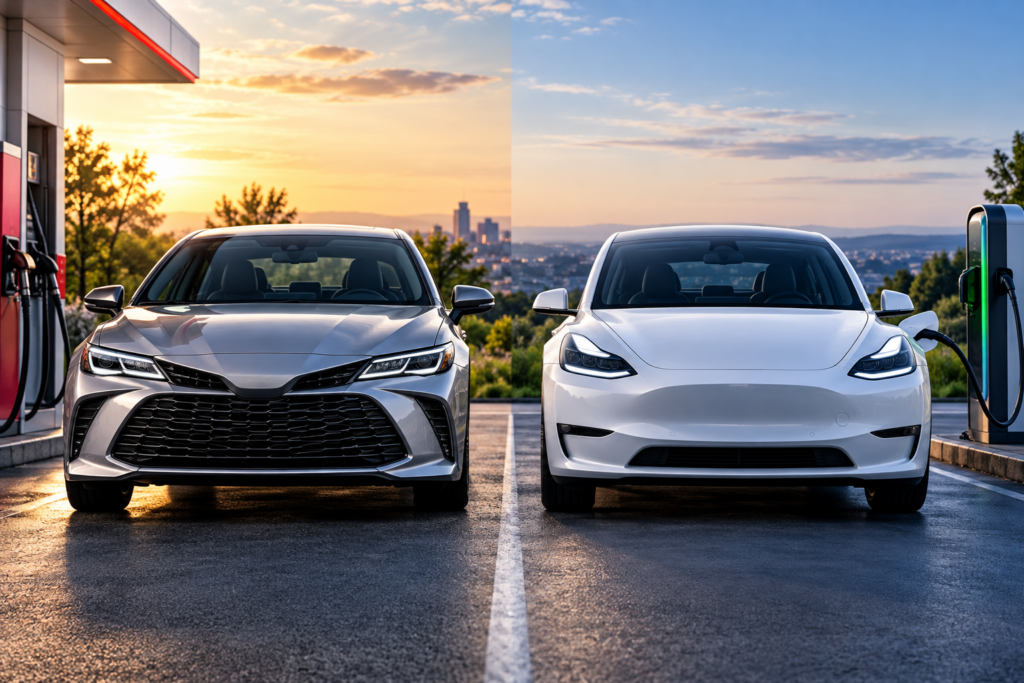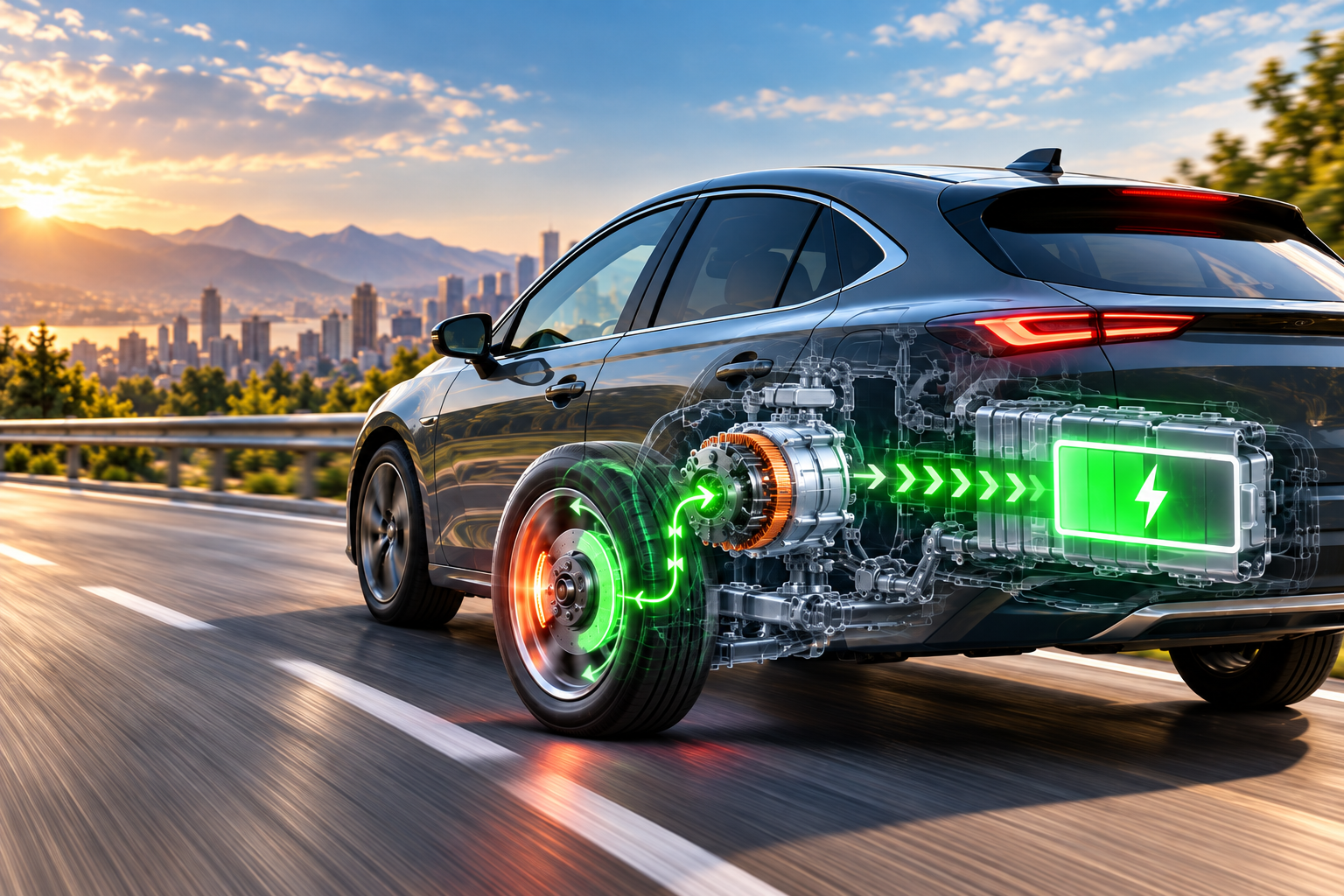
One of the technologies that makes hybrid and electric vehicles fundamentally different from conventional cars is regenerative braking.
Instead of converting all of the vehicle’s movement into heat through traditional friction brakes, an electrified drivetrain can recover part of that energy and return it to the high-voltage battery.
The process happens automatically in the background, but understanding how it works explains a lot about hybrid fuel economy, electric vehicle efficiency and even why brake components can wear differently in electrified cars.
To understand regenerative braking, it helps to look at what normally happens when a car slows down.
In a conventional vehicle, pressing the brake pedal causes brake pads to press against discs or drums. Friction slows the vehicle, but the kinetic energy of the moving car is largely converted into heat and lost.
A hybrid or electric car can recover some of that energy.
When the driver lifts off the accelerator or presses the brake pedal, the electric motor can reverse its normal role.
Instead of using electricity to create movement, it uses the vehicle’s movement to generate electricity.
The motor creates resistance while generating electricity, and that resistance helps slow the vehicle.
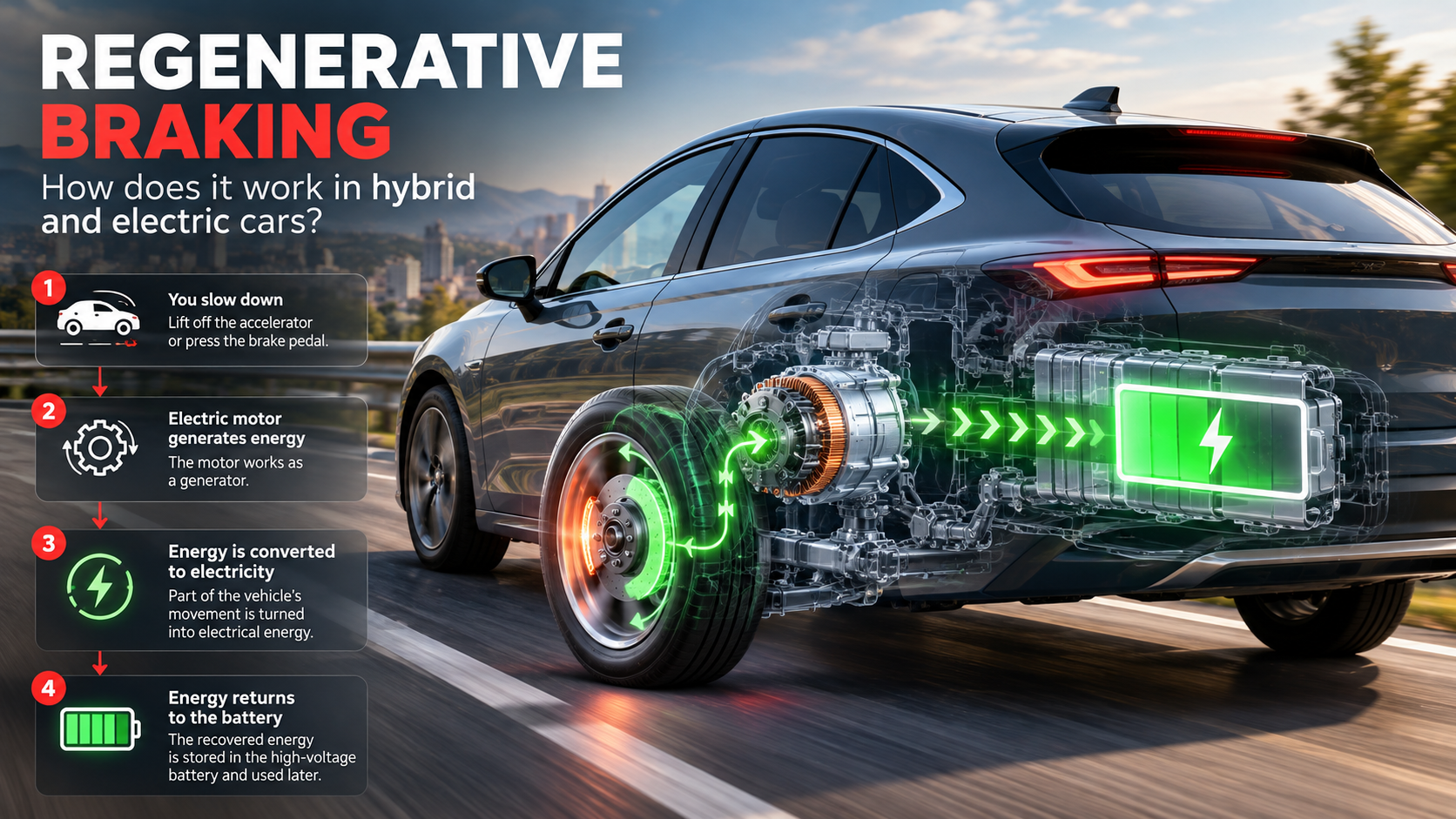
The electricity generated during regenerative braking is sent back to the high-voltage battery.
The battery can then use that energy later to power or assist the electric motor.
This creates a cycle in which some of the energy normally lost during braking is reused.
Yes, but not in the same way as plugging a vehicle into a charger.
Each braking event normally returns a relatively small amount of energy to the battery.
Over an entire journey, however, repeated deceleration can make a meaningful contribution to efficiency.
This is especially important in:
City journeys involve repeated cycles of acceleration and deceleration.
Every time the vehicle slows down, the hybrid or EV potentially has an opportunity to recover energy.
This is one of the reasons hybrids can achieve strong fuel economy in urban environments.
Our guide to hybrid car fuel economy explains why city and motorway consumption can differ so much.
The basic principle is the same, but the way it is used can differ.
Recovered energy is stored in a relatively smaller high-voltage battery and later used to assist the combustion engine or provide short periods of electric driving.
Regeneration feeds energy back into the main traction battery and can contribute directly to extending usable driving range.
Some EVs also offer much stronger regenerative braking than typical hybrids.
Some electric vehicles allow drivers to use strong regenerative braking when they lift off the accelerator.
This can slow the vehicle significantly without immediately using the conventional brake pedal.
In certain driving situations, the driver may control both acceleration and much of the deceleration using one pedal.
This is commonly referred to as one-pedal driving.
Not every hybrid or EV offers one-pedal driving, and the strength of regeneration varies significantly between manufacturers.
Not necessarily.
Many electrified vehicles use a system known as blended braking.
The vehicle combines regenerative braking with conventional friction braking depending on how much braking force is required.
During light or moderate braking, regeneration may provide a significant part of the deceleration.
If stronger braking is needed, the conventional brake system contributes more heavily.
Greater opportunity for regenerative braking.
Regeneration and friction brakes may work together.
Maximum stopping performance takes priority over energy recovery.
It can.
Because regenerative braking can slow the vehicle without relying entirely on friction brakes, brake pads may experience less wear than in a comparable conventional vehicle.
However, this creates an interesting side effect.
Brakes that are used less frequently can sometimes develop corrosion or sticking components.
Brake discs naturally develop surface corrosion when exposed to moisture.
In a conventional vehicle, regular braking often cleans this surface quickly.
In a hybrid or EV, friction brakes may be used less intensively because regeneration performs part of the braking work.
This can allow corrosion to become more noticeable, particularly on vehicles used for short journeys or driven in wet climates.
Absolutely.
Brake servicing can include inspection of:
Hybrid maintenance still includes conventional vehicle systems alongside high-voltage technology.
Read more in our complete guide to hybrid car maintenance.
No.
Energy conversion is never completely efficient, and there are situations where regeneration is limited or unavailable.
Factors can include:
The battery needs somewhere to store the recovered energy.
If the battery is already at or near its permitted upper charge limit, the vehicle may reduce regenerative braking.
The conventional brakes then need to provide more of the deceleration.
Drivers of some electrified vehicles may notice that the vehicle feels slightly different under these conditions.
It can.
Battery performance changes at low temperatures, and the vehicle may limit how much energy can be returned to the battery until operating conditions improve.
This means regenerative braking may feel weaker when the vehicle is first driven in cold weather.
As the battery reaches a more suitable temperature, regeneration may become stronger again.
Vehicle stability always takes priority over energy recovery.
On wet, icy or otherwise low-grip surfaces, control systems may adjust regenerative braking to help maintain traction.
ABS, traction control and stability systems work together with the electrified drivetrain to manage braking forces safely.
Smooth and predictable driving generally gives the system more opportunity to recover energy.
The goal is not to drive slowly everywhere.
It is to reduce unnecessary energy use and avoid repeatedly accelerating hard only to brake heavily a few seconds later.
Not necessarily.
Maximum regeneration is not automatically the same as maximum overall efficiency.
If you slow down unnecessarily and then need to accelerate again, energy has still passed through several conversion stages, each with some losses.
When possible, maintaining momentum can be more efficient than repeatedly slowing and accelerating.
Anticipate traffic and preserve momentum when it is safe and appropriate.
Regenerative braking can recover part of the energy instead of losing all of it through friction.
Yes, it is one of the key reasons hybrid vehicles can use fuel efficiently.
Energy recovered during braking reduces the amount of energy that must later come from the combustion engine.
The effect becomes particularly valuable in city and mixed driving, where braking happens frequently.
That is why regenerative braking, electric assistance and engine shut-off work together rather than operating as isolated technologies.
It can recover energy that would otherwise be lost, so it contributes to overall EV efficiency and available range.
However, regenerative braking cannot replace charging.
The vehicle always uses more energy to accelerate than can later be recovered during braking because of energy losses in the complete system.
Regeneration recovers some energy during deceleration. It does not create enough energy to continuously recharge the battery and keep the vehicle driving indefinitely.
Changes do not always mean something is wrong.
Regenerative braking can vary because of:
However, a sudden or persistent change combined with dashboard warnings may justify diagnostics.
Yes.
Regenerative braking depends on several components working correctly, including:
If the vehicle detects a fault in one of these systems, regenerative braking may be reduced or disabled.
If a warning appears, read our guide to the hybrid warning light and what it can mean.
It is possible for regeneration to become unavailable because of a fault, but conventional friction brakes are designed to remain available for vehicle braking.
The exact behaviour depends on the vehicle and fault condition.
If braking behaviour changes significantly or warning messages appear, the vehicle should be inspected by a specialist.
The braking system in a hybrid or EV interacts with the high-voltage drivetrain and electronic control systems.
Diagnosing unusual regenerative braking behaviour may require analysis of:
HybridElectric workshops offer specialist hybrid and EV diagnostics and servicing across the network.
Regenerative braking uses the electric motor as a generator while the vehicle slows down. Part of the vehicle’s kinetic energy is converted into electricity and returned to the high-voltage battery.
Not always. During lighter braking, regeneration can provide part of the stopping force. Conventional friction brakes are added when more braking force is required.
In hybrid vehicles, recovered energy can later assist the electric motor and reduce the amount of work required from the combustion engine, contributing to better fuel efficiency.
It returns some energy to the battery during deceleration, but this is energy the vehicle previously used to accelerate. An EV still requires external charging.
The battery has limited ability to accept additional energy when it is near its permitted upper charge level, so the vehicle may temporarily reduce regeneration.
Yes, but the amount of available regeneration may be reduced when the battery is very cold or when road conditions require additional traction control intervention.
They often can because regenerative braking reduces friction brake use. However, brake components still require regular inspection and can suffer from corrosion or sticking.
Regenerative braking is a good example of how conventional vehicle systems and high-voltage technology increasingly work together.
When these systems require maintenance or diagnostics, specialist knowledge becomes important.
The HybridElectric workshop network connects workshops experienced in hybrid and electric vehicle diagnostics, batteries, braking systems and advanced high-voltage repairs.
Find a HybridElectric workshop for specialist diagnostics, maintenance and repair of modern electrified vehicles.
Find a workshop Explore our services